Acoustofluidics

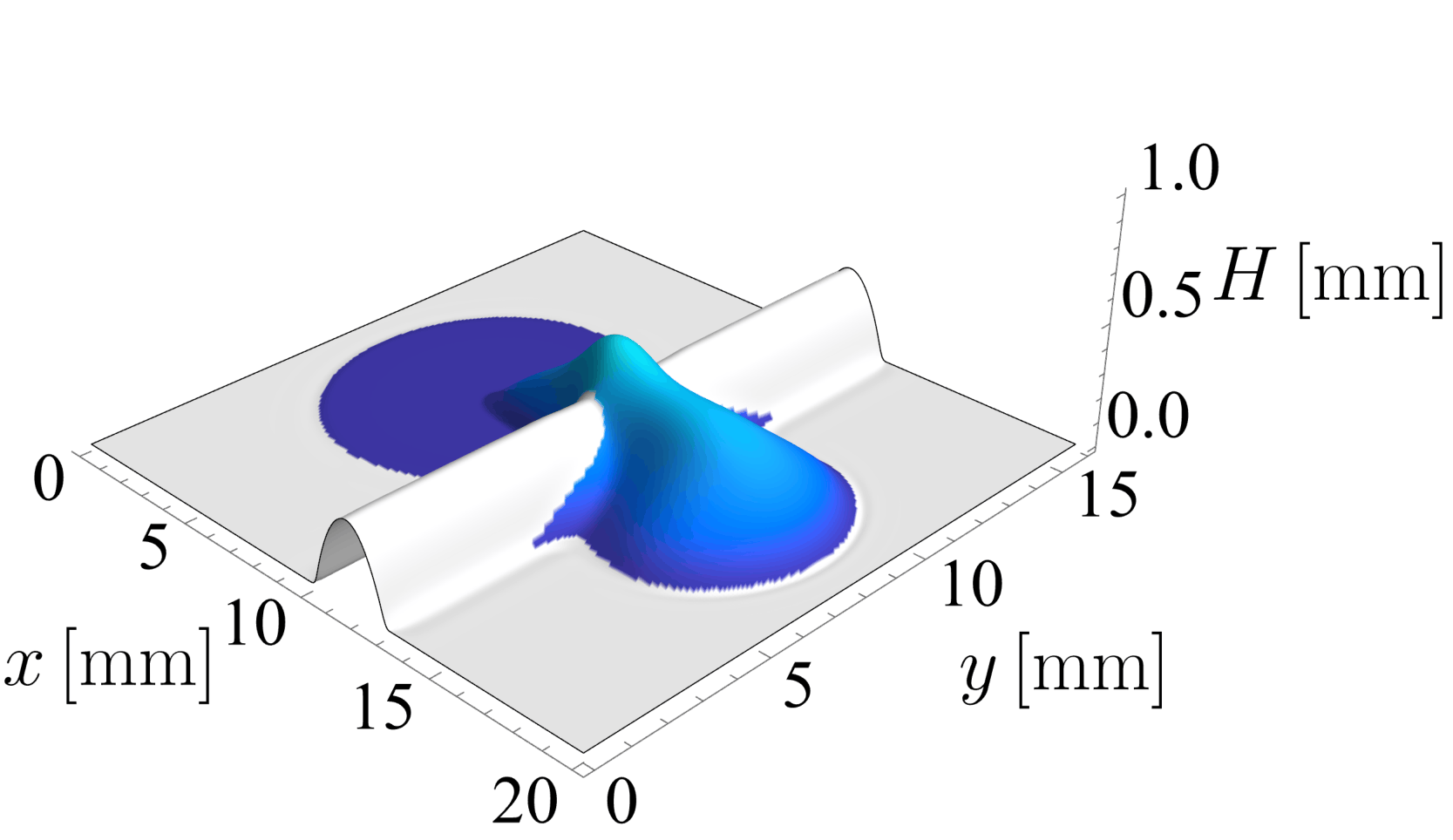
Over the last several decades, there has been significant interest in understanding the physics of surface acoustic wave (SAW) driven droplets and emulsions. This phenomenon provides utilization in actuating microfluidic platforms, for cooling electronic circuits, and for a variety of manufacturing applications. Experiments conducted in the MINiSURF Lab (Technion - Israel Institute of Technology) demonstrated that for single-phase, macroscopic drops the acoustic forcing arises from Reynolds stress variations in the liquid due to changes in the intensity of the acoustic field leaking from the SAW beneath the drop and the viscous dissipation of the leaked wave. The result is quasi-constant translation of drops in the direction of wave propagation. We have developed theoretical models for these drops that describe the interplay between gravitational, capillary, and acoustic forces to qualitatively capture the observed dynamics. Further experiments were conducted on silicone oil-water emulsions which demonstrated the ability to phase separate the system into its constituent components. A microscopic model was developed to better understand the interplay between the dominant forces operating on the system.

Recent Publications


M. Fasano, Y. Li, J. A. Diez, J. D’Addesa, O. Manor, L. Cummings, and L. Kondic, Modelling the dynamics of an oil drop driven by a surface acoustic wave in the underlying substrate, J. Fluid Mech., 1022, A49, (2025)


We present a theoretical study, supported by simulations and experiments, on the spreading of a silicone oil drop under MHz-frequency surface acoustic wave (SAW) excitation in the underlying solid substrate. Our time-dependent theoretical model uses the long-wave approach and considers interactions between fluid dynamics and acoustic driving. While similar methods have analysed the micron-scale oil and water film dynamics under SAW excitation, acoustic forcing was linked to boundary layer flow, specifically Schlichting and Rayleigh streaming, and acoustic radiation pressure. For the macroscopic drops in this study, acoustic forcing arises from Reynolds stress variations in the liquid due to changes in the intensity of the acoustic field leaking from the SAW beneath the drop and the viscous dissipation of the leaked wave. Contributions from Schlichting and Rayleigh streaming are negligible in this case. Both experiments and simulations show that, after an initial phase where the oil drop deforms to accommodate acoustic stress, it accelerates, achieving nearly constant speed over time, leaving a thin wetting layer. Our model indicates that the steady speed of the drop results from the quasi-steady shape of its body. The drop speed depends on drop size and SAW intensity. Its steady shape and speed are further clarified by a simplified travelling-wave-type model that highlights various physical effects. Although the agreement between experiment and theory on drop speed is qualitative, the results’ trend regarding SAW amplitude variations suggests that the model realistically incorporates the primary physical effects driving drop dynamics.

Animations: 1 2

J. M. Marcos, Y. Li, M. Fasano, J. A. Diez, L. J. Cummings, O. Manor, and L. Kondic, Monte Carlo-based model for the extraction of oil from oil-water mixtures using wetting and surface acoustic waves, Phys. Rev. E, 112, 025502, (2025)


This work presents a Monte Carlo–based microscopic model for simulating the extraction of oil from oil-in-water emulsions under the influence of surface acoustic waves (SAWs). The proposed model is a two-dimensional Ising-lattice gas model that employs Kawasaki dynamics to mimic the interactions between oil, water, and air, as well as external forces such as gravity and acoustic stress. By incorporating both acoustic streaming and acoustic radiation pressure, the model captures key experimental observations, including selective oil extraction and droplet motion under SAW excitation. The results highlight the critical role of acoustic radiation pressure in enabling oil film formation and detachment, governed by the balance between capillary and acoustic stresses. The study provides qualitative agreement with experimental findings and offers insights into the essential mechanisms driving acoustowetting-induced phase separation, demonstrating the utility of discrete modeling for complex fluid dynamics problems.

Y. Li, J. M. Marcos, M. Fasano, J. Diez, L. J. Cummings, L. Kondic, and O. Manor, Using wetting and ultrasonic waves to extract oil from oil/water mixtures, J. Coll. Int. Sci., 700, 138442, (2025)


Oil and water placed atop of a solid surface respond differently to a MHz-level surface acoustic wave (SAW) propagating in the solid due to their different surface wetting properties. We observe that, under SAW excitation, oil films, whether non-organic silicon oil or organic sunflower oil, are extracted continuously from sessile drops, comprising emulsions of the oil in question in a solution of water and surfactants. The mechanism responsible for the extraction of oil from the mixtures is the acoustowetting phenomenon: the low surface tension oil phase leaves the mixture in the form of ‘fingers’ that, away from the drop, spread opposite the path of the SAW. The high surface tension water phase remains at rest. Increasing either the SAW intensity or the oil content in the mixture enhances the rate at which oil leaves the emulsion. We further observe acoustic-capillary flow instabilities at the free surface of the oil film and the formation of spatial gradients in the emulsion oil-concentrations in the presence of SAW. Our study suggests the potential for using SAW for heterogeneous removal of oil from oil-in-water mixtures to complement current phase separation methods.

M. Fasano, J. A. Diez, O. Manor, L. Kondic, and L. J. Cummings, Phase separation of a binary fluid mixture under external forcing, J. Eng. Math., 152, 12, (2025)


We present a simplified, thermodynamically consistent model of the phase separation of a binary fluid mixture under the effects of a conservative volume force that drives fluid flow. Enforcing conservation of mass provides advection–diffusion equations for the concentrations of the individual components. We propose Darcy-type laws for the velocity and flux of each component, that ensure a nonincreasing free energy functional consistent with the second law of thermodynamics in an isothermal setting. The model is closed by prescribing a free energy in accordance with the Cahn–Hilliard and Flory–Huggins theories. A linear stability analysis of the unforced model yields the range of initial concentrations for which instability occurs and the linear growth rate of perturbations, which are numerically confirmed. We provide fully nonlinear numerical solutions to the model in the specific case of a silicone oil–water mixture, where the conservative force is generated by gravity, or by a surface acoustic wave (SAW) propagating through the underlying substrate. In agreement with recent experimental results, we find that increasing the SAW amplitude or decreasing the SAW attenuation length speeds up total phase separation. This provides a proof-of-principle for modeling phase separation due to the effects of a SAW, within the limitations of our model.